 DevEdge
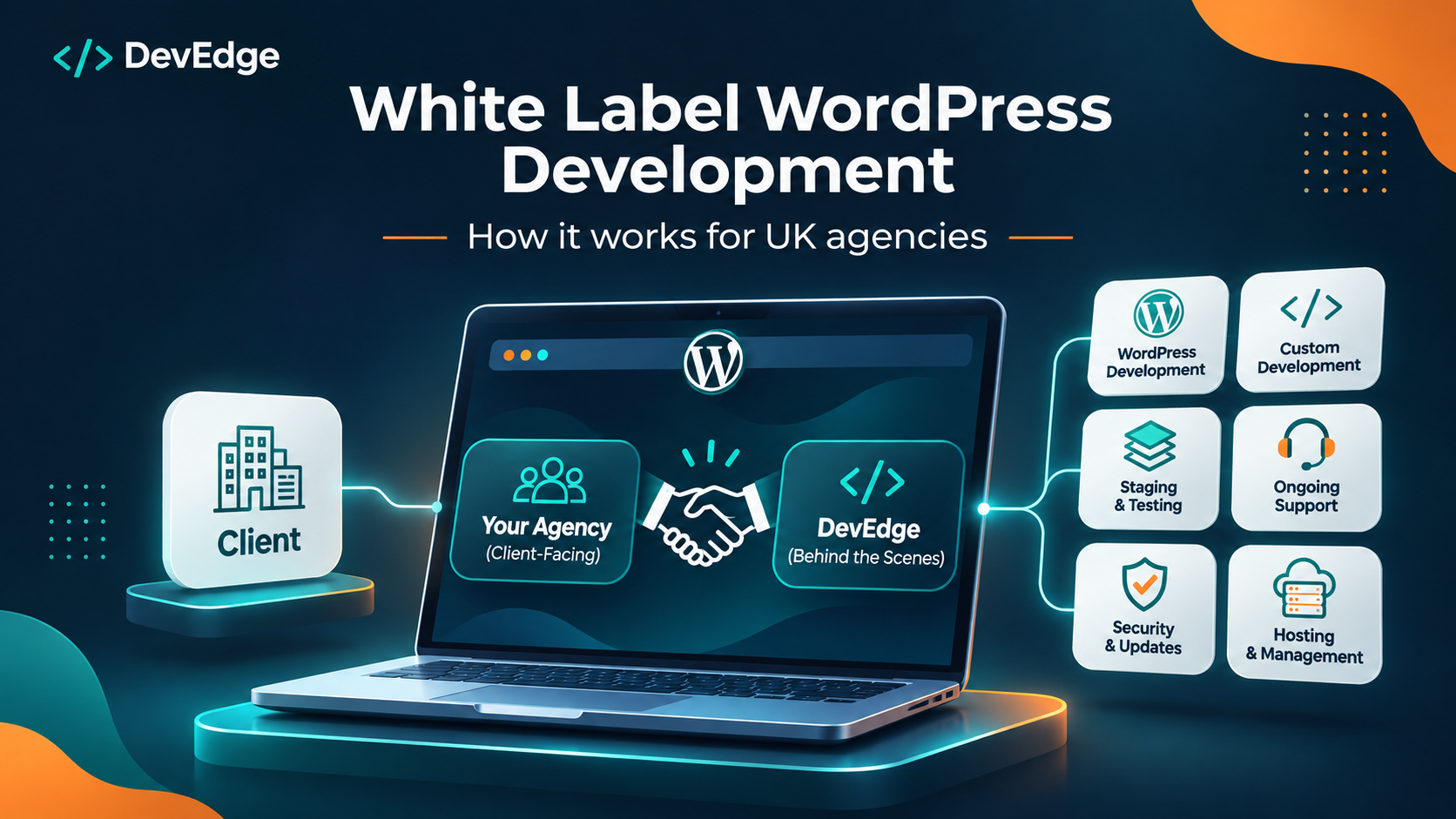
You have won a WordPress build, the client is keen to start, and your developer is already booked solid. Or perhaps you are a design studio that keeps handing the build to someone else. This is where white label WordPress development comes in: a development partner builds the site, and it goes out under your agency’s name.
This guide covers how it works for UK agencies in practice: what it is, how a project runs from brief to launch, how it compares with hiring, what to check before you pick a partner, and how pricing is usually structured.
What white label WordPress development is
A white label partner does the design and development work behind the scenes, and you present it to your client as your own. You keep the client relationship, you set the price, and you invoice the client. The partner invoices you.
It is not a referral arrangement. At DevEdge, we build under your brand and your NDA, and you keep ownership of every build: the bespoke code, the theme and the repository. Case studies or portfolio use happen only with your permission. You can read the full detail on our white label web development service page.
How a white label project works, step by step
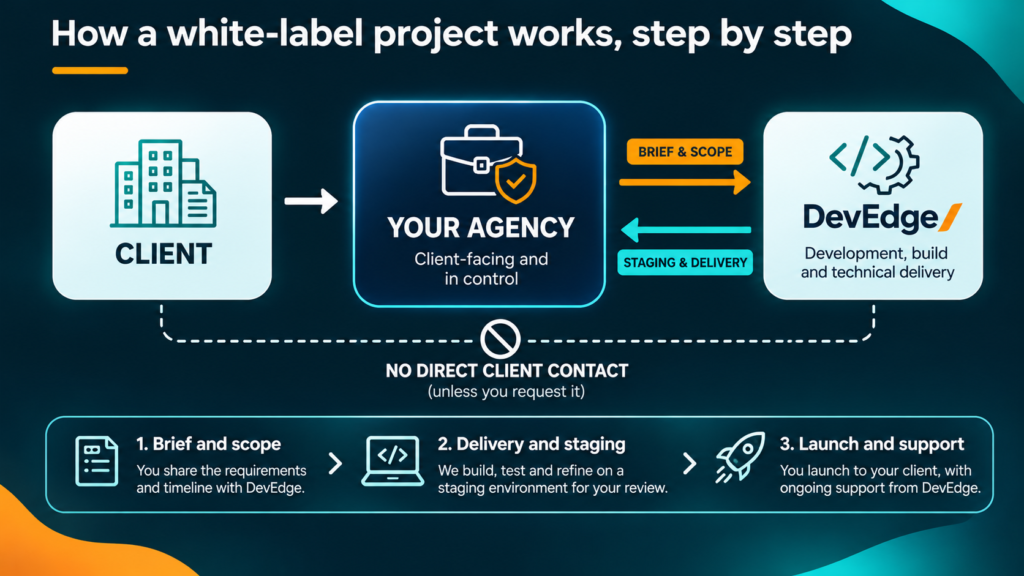
Every partner runs things slightly differently, but a good process keeps you in control at every stage. Ours has three phases, all managed through you.
1. Brief and scope
You share the client brief: the pages needed, functionality, designs or wireframes, integrations, content requirements and preferred timescale. We review it, ask any technical questions, and come back with an agreed price and timeline that you can put in front of your client. We can work from Figma files, wireframes, design systems and your own development conventions.
2. Delivery and staging review
Design and development are handled end to end, then reviewed with you on staging before anything reaches your client. Staging links are unbranded. Feedback comes through you, and any request that materially changes the scope is discussed with you before extra work is carried out.
3. Launch and ongoing support
At handover, the admin login screen and system emails are in your agency’s name, and client-facing documentation carries your brand. After launch you can take the site back in-house, or we can stay behind the scenes for updates, fixes and future phases. Many partners resell a website support plan as their own care package.
In-house hire or white label partner?
Before choosing a partner, it is worth being honest about the alternative. A permanent developer costs more than a salary. On top of pay, an employer in the UK has to budget for:
- Employer National Insurance. Since April 2025, employers pay Class 1 National Insurance at 15% on earnings above the secondary threshold, up from 13.8%, and that threshold fell to £5,000 a year (see HM Treasury rates and allowances and current HMRC rates and thresholds).
- Workplace pension. This is a separate cost. Under automatic enrolment, the employer must pay at least 3%, in most schemes worked out on earnings between £6,240 and £50,270 a year (GOV.UK workplace pensions).
- Everything else. Recruitment time, equipment and software, holiday and sick cover, and the management time needed to review code and plan work.
None of that makes hiring wrong. It just means the decision is about the shape of your pipeline as much as the cost. A few questions help:
- Is development work steady or lumpy? If builds arrive in bursts, a salary is paid through the quiet months too. A partner is paid for work delivered.
- How quickly do you need to start? Hiring can take weeks or months. Partner capacity can be agreed around your pipeline.
- What skills do projects need? One hire brings one person’s skill set. A partner can cover custom themes, Gutenberg blocks, WooCommerce, integrations, migrations and performance work.
- Who covers holidays and illness? With one developer, work can stall when they are away. Ask any partner how they handle cover.
Some agencies do both: they keep a small in-house team and use a partner for overflow when a deadline moves. Our white label development partnership supports single projects, retained monthly days or overflow work.
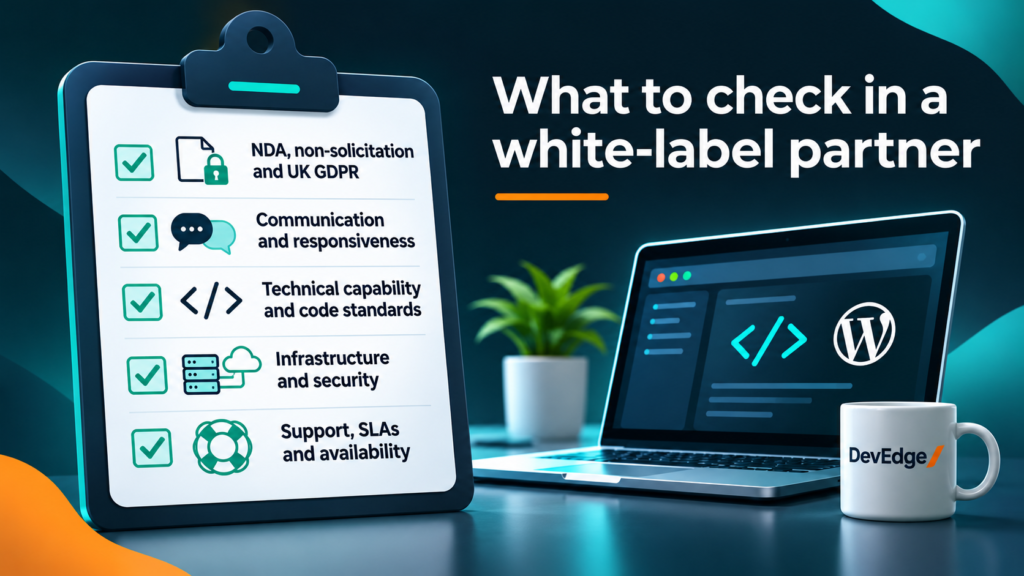
What to check in a white label partner
NDA, non-solicitation and UK GDPR
A partner should sign your NDA without fuss. Remember that an NDA covers confidentiality; if you also want a clause stopping the partner approaching your clients, ask for non-solicitation terms in writing too.
There is also a UK-specific point many guides skip. If the partner will handle personal data, such as WooCommerce orders or form entries, the ICO explains that UK GDPR requires a written contract whenever a controller uses a processor, and that the same obligations apply when a processor uses another processor. Your client, your agency and your partner form exactly that chain. DevEdge publishes a Data Processing Agreement for this reason.
Communication and client contact
Find out who your point of contact is and how updates reach you. Ask what happens if you want the partner on a client call. We never contact the end client unless you ask, and we can join calls as part of your delivery team if you want us to.
Code quality and ownership
Ask how they build and whether they will follow your conventions, and make sure the code and repository are yours. Check there is no hidden “built by” credit in the footer. Apart from giving the game away, Google lists widely distributed links in the footers or templates of various sites as a form of link spam.
Hosting
Decide early where the site will live. Our Agency Hosting runs your portfolio on its own isolated server, with client sites separated into individual cPanel accounts, white-label nameservers, daily off-server backups and Cloudflare protection. Standard WordPress migrations are included in onboarding, tested on temporary URLs before DNS changes. Our posts on why DevEdge hosting delivers faster results and moving a website with minimal downtime cover the detail.
Support and emergency cover
Ask who will be looking at a client’s shop if it goes down at 3am. Agency Hosting covers the infrastructure, but WordPress core, plugin and theme updates sit under Website Support or your own team. For sites that cannot wait until morning, Emergency Response adds 24/7 monitoring with an engineer investigating within 2 hours of a qualifying P1 alert.
How white label pricing usually works
Prices vary with scope, so treat any figure you see without a brief with caution. The models themselves are fairly standard:
- Fixed project quote. One brief, one agreed price and timeline. This is the most common starting point.
- Retained capacity. A set number of days each month reserved for your pipeline, with priority scheduling and a predictable monthly cost.
- Overflow. Extra hands when your team is at capacity, scoped quickly and delivered to your standards.
- Hourly or day rate. Some partners charge by time for open-ended work. Agree how changes are approved before they are billed.
Whatever the model, you decide what to charge your client, so the margin is yours.
Frequently asked questions
Not unless you want them to. Staging, documentation and communications are unbranded or in your agency’s name, and we never contact your client directly unless you ask.
Yes. We are happy to work under your NDA and treat project details, client information and commercially sensitive material as confidential.
You do. DevEdge invoices your agency for the agreed work, and what you charge your client is entirely up to you.
Yes. There is no requirement to commit to retained capacity or an ongoing arrangement. One brief with one fixed price is the most common starting point.
You or us. We can hand the site back to your team, or provide maintenance and support behind the scenes that you resell as your own care plan.
Talk to us about white label
If you have a brief waiting or want spare development capacity for the next busy spell, see how our white label WordPress development for agencies works, or get in touch and send us what you have. We will come back with an agreed price and timeline before any work begins.
